Peaks & Routes·Reference entry
Mount Stuart's North Ridge as a Problem in Granite
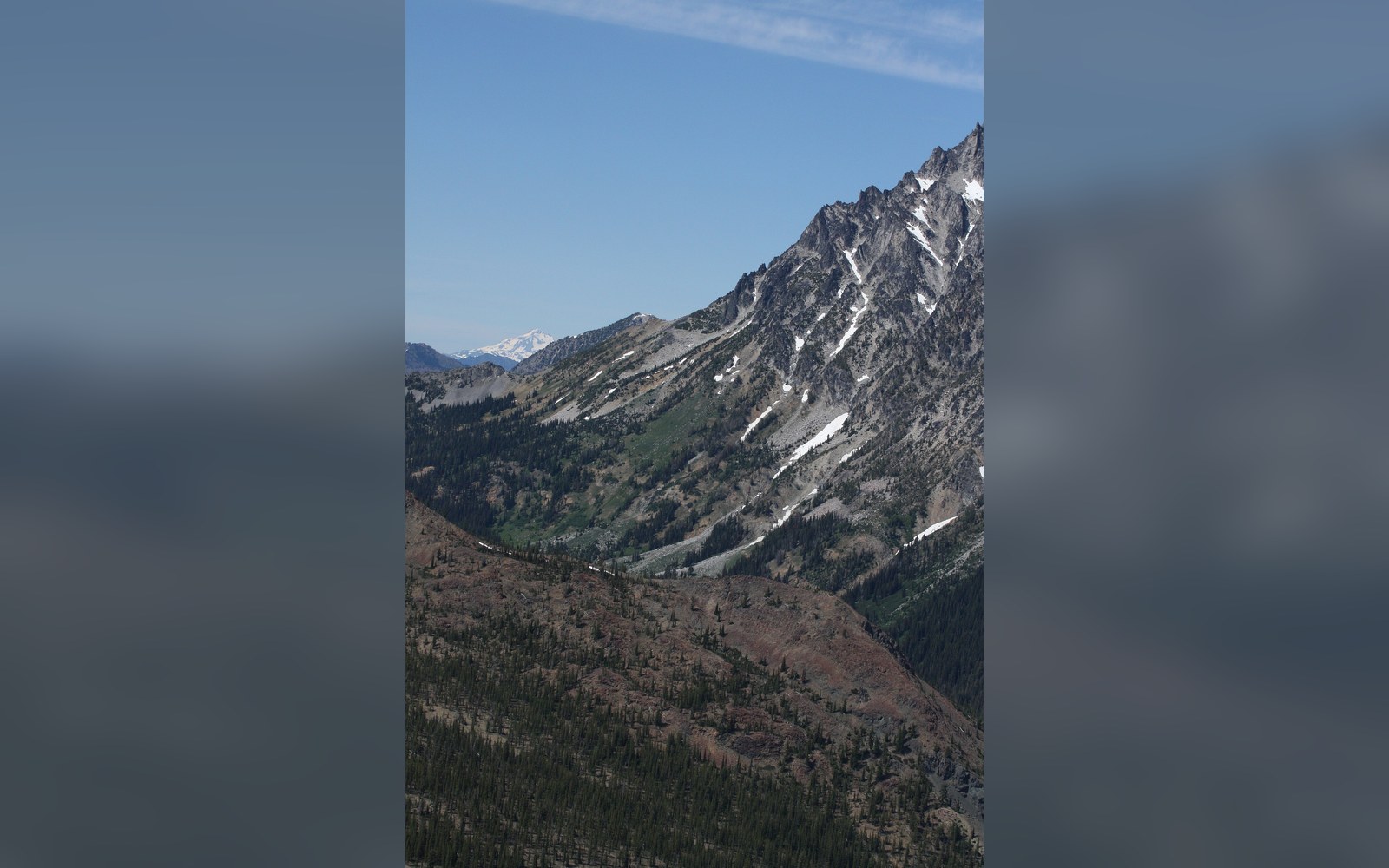
Photo: Mount Stuart 7814 · Wikimedia Commons
The formation and the rock it stands on
Mount Stuart rises to 9,415 feet at the eastern edge of the Stuart Range, above the Icicle Creek drainage south of Leavenworth. It is the second-highest non-volcanic peak in Washington, and the rock beneath it is the reason the mountain looks the way it does.
The Stuart batholith ↗ is a coarse-grained granitic intrusion — quartz diorite grading toward true granite — emplaced roughly 90 million years ago during the Cretaceous. The batholith's texture is noticeably coarser than the Index batholith to the northwest, and its extent is considerable: it underlies the entire Stuart Range and reaches into the margins of the Enchantments basin to the east. Erosion has stripped the overlying rock and left the pluton exposed as a series of ridges, spires, and faces. The North Ridge is the longest and most articulated of those features.
The ridge runs approximately 1.5 miles from the base of the buttress to the summit. Its vertical relief exceeds 3,000 feet. By most measures it is the longest technical rock route in the Cascades — a claim grounded in the route's unbroken elevation gain on rock rather than snow or mixed terrain. That distinction belongs to the geology as much as to the climbers.
Chronology
- 1883First recorded summit ascent, survey party
- 1906The Mountaineers founded in Seattle
- Mid-20th centuryFirst ascent of the North Ridge
- 1976Alpine Lakes Wilderness Act designates the Stuart Range under Forest Service protection
The first-ascent record
The summit of Mount Stuart was first reached in 1883 ↗ by a survey party, establishing the peak in the record before technical climbing had any presence in the Cascades. The North Ridge is a different problem entirely. It was not a survey objective; it was a route requiring sustained rock climbing over a long day, and its first ascent waited for a different generation.
The North Ridge was first climbed in 1935 by a party that included members associated with The Mountaineers, the Seattle-based club founded in 1906 that anchored the documentation of Washington's climbing record through much of the early twentieth century. The route's character — long, committing, and entirely on rock — made it an outlier in a period when Washington climbing was largely oriented toward glaciated peaks and mixed alpine routes.
Fred Beckey, whose name runs through the Washington first-ascent record more than any other, did not make the first ascent of the North Ridge, but his documentation of it in the Cascade Alpine Guide gave the route its lasting reference framework. Beckey's three-volume guide, published by The Mountaineers Books ↗, remains the primary printed record for Stuart Range routes, including the North Ridge's position in the regional hierarchy.
Key measurements
- Summit elevation: 9,415 feet
- North Ridge vertical relief: exceeds 3,000 feet
- Ridge length: approximately 1.5 miles, base to summit
- Batholith age: approximately 90 million years (Cretaceous)
What the ridge represents in the record
The North Ridge stands apart from the glaciated peaks that dominate Washington's popular climbing imagination — Rainier, Baker, Shuksan — because it is purely a rock problem. There is no glacier approach in the technical sense, no ice axe work on the route itself. The Stuart batholith is the climb: its cracks, its faces, its weathered edges. The coarseness of the rock gives purchase; the scale of the ridge is the real difficulty.
In the broader geography of Washington climbing, the North Ridge sits within the Alpine Lakes Wilderness, designated in 1976, which placed the Stuart Range under U.S. Forest Service wilderness protections and fixed the administrative boundary around one of the state's most concentrated collections of named technical objectives. That designation has no bearing on the first-ascent record, but it determines which agency now holds authority over the land the ridge stands on.
The North Ridge is documented, named, and first-ascended. As a feature of the Washington record, its significance is geological first — the exposed face of a 90-million-year-old intrusion — and historical second: a long problem in granite that took the range's climbers until 1935 to solve.
The Stuart batholith ↗ is a coarse-grained granitic intrusion — quartz diorite grading toward true granite — emplaced roughly 90 million years ago during the Cretaceous.