Crags·Reference entry
Basalt That Broke Off in Columns
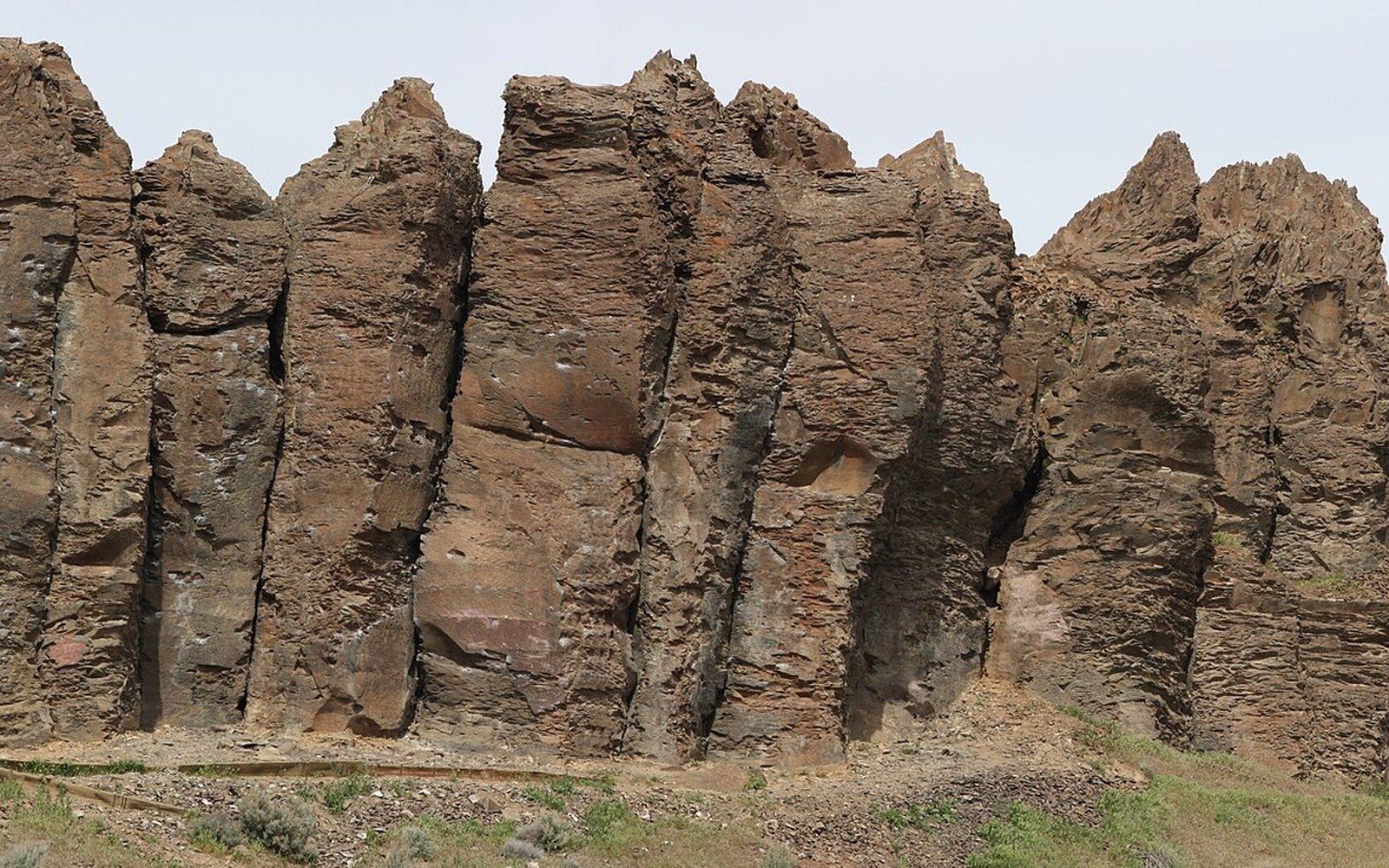
Photo: Columbia River Basalt Group 1943-4 panorama · Wikimedia Commons
The Feathers at Frenchman Coulee, and the rock beneath the record
Frenchman Coulee is a dry channel cut by catastrophic Ice Age floods into the Columbia Plateau east of the Cascades. The coulee itself is unremarkable from the highway — sagebrush, basalt scarp, the flat light of the Columbia Basin. Walk down into it, and the walls close around a formation called The Feathers: a cluster of free-standing basalt columns, each tens of feet tall, arranged in a rough fan and separated by vertical cracks that run nearly the full height of the stone. The name is descriptive. From a distance, the columns lean and splay like the barbs of a large feather.
The rock they are made of belongs to the Columbia River Basalt Group — the sequence of flood basalts that buried most of eastern Washington between roughly 17 million and 6 million years ago. Individual flows, some more than a hundred feet thick, poured from fissures in what is now eastern Oregon and southeastern Washington, traveled hundreds of miles, and stacked into a plateau that geologists measure in cubic miles. The total volume is estimated at around 170,000 cubic kilometers, making the Columbia River Basalt Group one of the largest continental flood basalt provinces on Earth.
Chronology
- ~17–6 million years agoColumbia River Basalt Group flows cover eastern Washington
- Last Ice AgeMissoula Floods erode the Columbia Plateau and expose columnar formations at Frenchman Coulee
- 1960sfirst documented climbing activity at Frenchman Coulee appears in regional trip reports
- 1970s–1980snamed routes accumulate on The Feathers and adjacent walls; site enters regional guidebook record
How a Column Forms
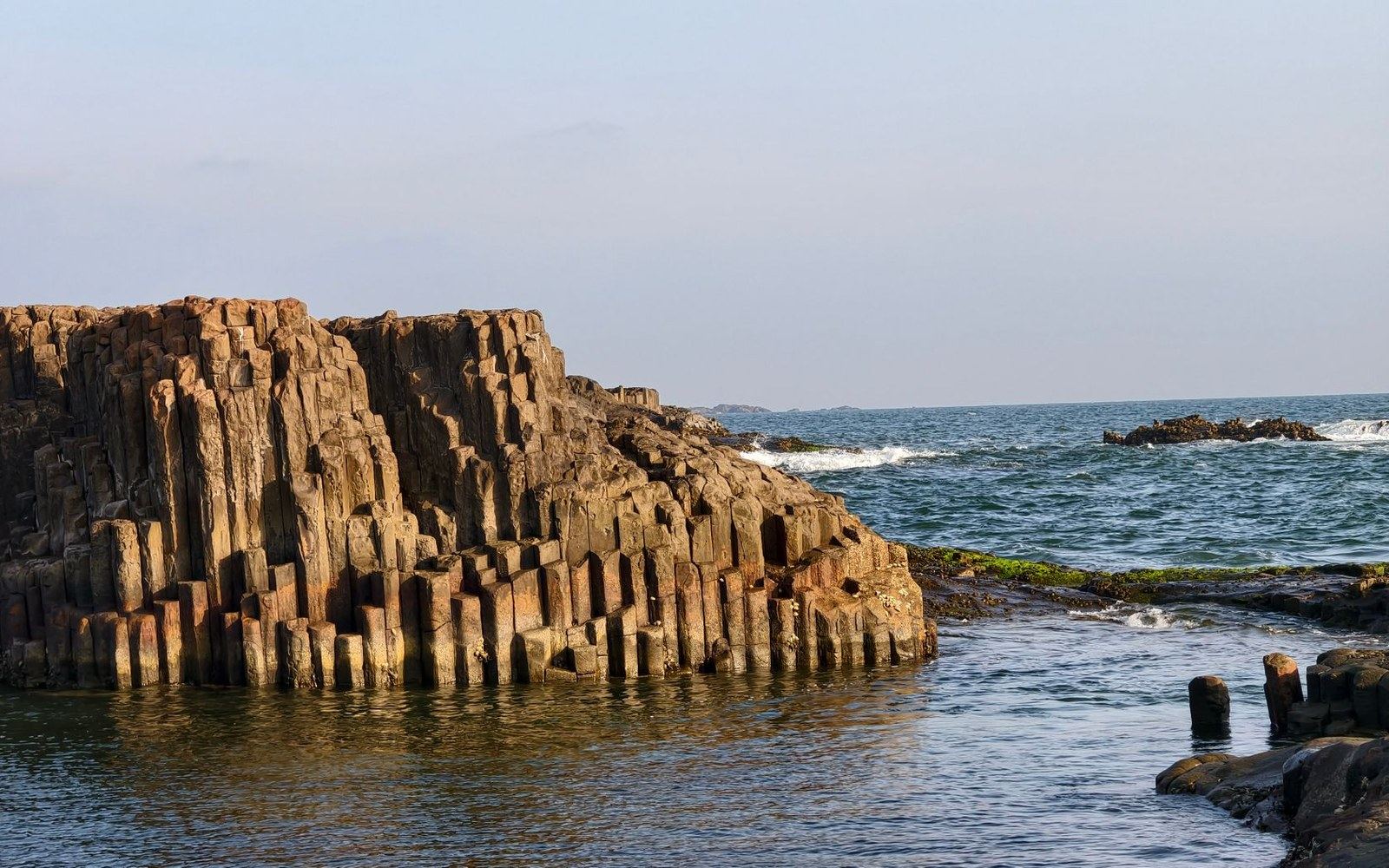
The geometry of The Feathers is not an accident of erosion. It is the direct consequence of how basalt cools. When a thick lava flow solidifies from the top and bottom simultaneously, it contracts as heat escapes. Contraction produces stress, and stress concentrates at evenly spaced points across the cooling surface. Cracks propagate downward from those points, meeting at angles that tend toward 120 degrees — the geometry of a hexagon, the shape that most efficiently relieves equal stress in every direction. The result is a network of prismatic columns, each bounded by its neighbors, each sharing a crack with the next. The process is the same one that produces the paving-stone patterns in a drying mudflat, operating at a vastly larger scale and in rock that will persist for millions of years.
At Frenchman Coulee, subsequent erosion by the Missoula Floods — the catastrophic drainages from a glacially dammed lake in what is now Montana, which swept across the Columbia Plateau repeatedly during the last Ice Age — quarried the plateau edge and left the columns exposed. Some fell. Some remained upright, isolated from the parent wall by the flood's hydraulic force and by millennia of freeze-thaw at the crack margins. The Feathers are what stayed standing.
Geology in brief
- Columbia River Basalt Group — the continental flood basalt sequence underlying the Columbia Plateau; one of the largest such provinces on Earth
- Columnar jointing — the hexagonal cracking pattern produced by uniform thermal contraction in a cooling basalt flow
- Missoula Floods — repeated catastrophic drainages from a glacially dammed lake that shaped the Columbia Plateau's surface features, including Frenchman Coulee
The Climbing Record
The first documented climbing at Frenchman Coulee dates to the 1960s, when the formation began to appear in trip reports circulated among climbers based in Seattle and Ellensburg. The columns at The Feathers offered something rare on the Columbia Plateau: vertical crack systems on sound, near-vertical rock, accessible without alpine approach, climbable in a single day from either side of the Cascades. The crack widths vary column to column, which means a single formation presents a range of jamming problems — finger, hand, and fist — across routes of similar height and comparable character.
Frenchman Coulee ↗ grew through the 1970s and 1980s as a destination for crack climbing practice, and routes accumulated on The Feathers and on adjacent walls throughout the coulee. By the time the site was well-documented in regional guidebooks, it held several dozen named routes. The Mountaineers and independent parties contributed to the record. The site's proximity to Interstate 90 — Vantage lies where the highway crosses the Columbia River — made it among the most accessible columnar basalt crags in the Pacific Northwest.
What the formation offered the historical record was specificity: a named place, a named rock type, a named process visible in the stone itself. The columns at The Feathers did not require a climber to name them to be what they are. The geometry was already there, baked in when the plateau cooled.
- ●Mount Erie
- ●Index
- ●Snow Creek Wall
- ●Castle Rock
- ●Peshastin Pinnacles
- ●Exit 38
- ▲Frenchman Coulee
- ●Royal Columns
Frenchman Coulee is a dry channel cut by catastrophic Ice Age floods into the Columbia Plateau east of the Cascades.