Land·Reference entry
How Basalt Becomes a Column
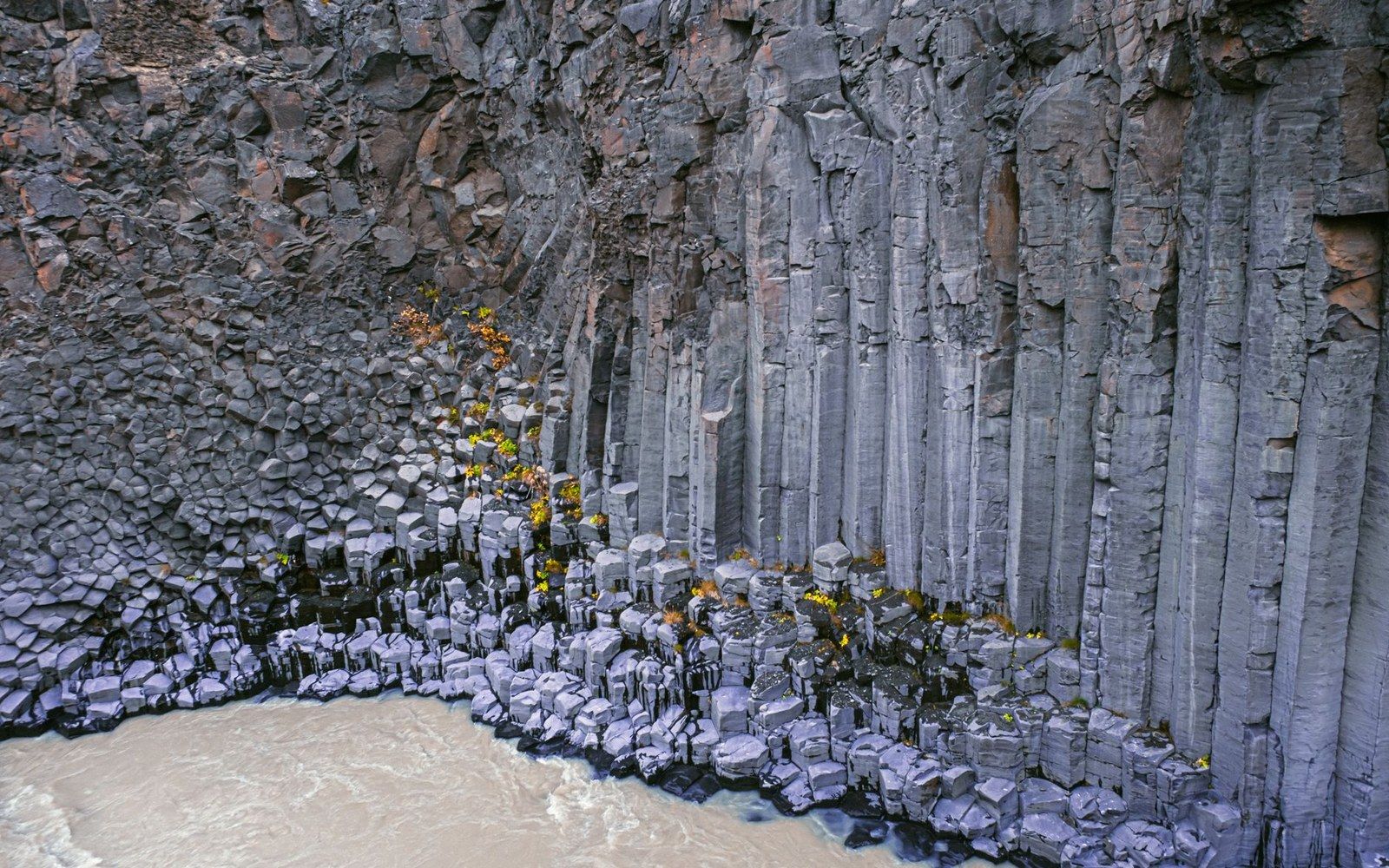
Photo: Monica Oprea / Pexels
The Rock and the Process
The hexagonal columns that climbers grip at Frenchman Coulee and the Royal Columns in the Tieton River canyon share a single origin: a flood basalt that buried much of eastern and central Washington between roughly 17 million and 6 million years ago. The Columbia River Basalt Group ↗ — a sequence of eruptions issuing largely from fissures in what is now northeastern Oregon and southeastern Washington — poured across the landscape in flows that could exceed one hundred feet of thickness in a single pulse. It is the cooling of those flows, not their eruption, that made the columns.
The mechanics are thermal contraction. As a thick lava flow loses heat, it shrinks. If it cools uniformly from a surface downward — which a flat, laterally extensive flow tends to do — the contracting rock develops a network of tensile fractures that propagate perpendicular to the cooling surface. The geometry that minimizes internal stress across a plane of uniform contraction is a hexagonal grid: six equal cracks meeting at roughly 120 degrees. The result is a set of columns that, ideally, look like a bundle of pencils — polygonal in cross section, oriented along the direction of heat flow, which in a flat flow means they stand upright.
The uniformity of the result depends on the evenness of cooling. Where a flow cools slowly and at a steady rate through a great depth, the columns grow long, wide, and regular. Where cooling is interrupted — by water infiltration, by contact with irregular terrain, or by proximity to another flow — columns become narrower, curved, or fanned. The three-dimensional fabric of a single flow therefore tells a detailed story: the broad, stable columns in the interior of a thick sheet represent ancient equilibrium; the bent or hackly rock near a flow's base records the chaos of initial contact with the ground.
Formation timeline
- Columbia River Basalt Group eruptions: approximately 17–6 million years ago
- Pleistocene Missoula Floods: revealed the columns at Frenchman Coulee by eroding surrounding material
- Human record: Tieton and Frenchman Coulee documented in Washington climbing literature from mid-twentieth century onward
The Crags Up Close
Frenchman Coulee, near Vantage on the Columbia River, exposes a cross section of this process at human scale. The Feathers — the named formation that defines the coulee's climbing — stand as a row of tall, freestanding columns separated by narrow slots. The columns there rise well above head height and hold diameters wide enough to wrap hands around; their regularity reflects a flow interior that cooled deep and undisturbed. The coulee itself was cut by Pleistocene floods — the same Missoula Floods that scoured much of eastern Washington — which eroded around the columnar joint sets and left the columns standing proud. The rock did not form the shape; the flooding revealed it.
The Royal Columns in the Tieton River canyon sit on the drier eastern slope of the Cascades and belong to the same basalt sequence, though here the columns often appear fanned or radiating rather than strictly vertical. That geometry indicates a flow that ponded against topographic relief and cooled in an orientation partly inclined to horizontal. The Tieton examples record variation within the same broad eruptive episode — same source chemistry, different thermal boundary conditions.
Mount Erie ↗, on Fidalgo Island near Anacortes, is sometimes mentioned alongside these crags but tells a different story. Its rock belongs to the Jurassic Fidalgo ophiolite, a slice of ancient ocean crust far older than the Columbia River Basalt, whose flows never reached the Fidalgo coast.
Key mechanism
- thermal contraction — rock shrinks as it cools; tensile fractures propagate perpendicular to the cooling surface
- hexagonal grid — the geometry that minimizes stress across a plane of uniform contraction; columns meet at ~120°
- column width — reflects cooling rate: wide = slow; narrow = fast or disturbed
- fan or curved columns — indicate inclined or uneven thermal boundary conditions (as at the Tieton)
The geometry that minimizes internal stress across a plane of uniform contraction is a hexagonal grid: six equal cracks meeting at roughly 120 degrees.
What the Joints Record
The joint pattern left in cooled basalt is not incidental decoration. Each crack is a record of a thermal gradient, a cooling rate, and a flow geometry. Where columns are wide, cooling was slow. Where they taper, cooling accelerated. Where they curve, the flow met an irregular surface or a source of water. The columnar jointing visible across Washington is, in this sense, a map of conditions that existed millions of years before any climber touched the rock — a geologic text written in contraction, preserved in stone, and eventually cut open by ice-age floods.